Sunday, January 27, 2008

JANUARY 2008/ MUHARAM 1429 OBITUARIES WITH 'DOA' FOR THE DEPARTED

'All praise and thanks belong to Allah alone, the One, the All-High, All Merciful. Blessings and Peace be upon Prophet Muhammad, the last of His messengers and prophets, his family, his Companions and all those who follow in his footsteps till the end of time'.

Much as January 2008 and Muharam 1429 respectively heralded the New Year for the Gregorian and Hijrah calender , they also tolled the passing of four persons whom I know in respect of my contact with them or their contribution to the country and the community at large. For sure there are many other departures.

Firstly I heard of the demise of a childhood friend whom only a fortnight earlier I had the blessing to have been talking on line and the sadness of not visiting him though I had made promises to do so. Hj Mahmud Hassan whom I knew since 1948 when we began our first entry into SAHC and met again several times during our professional career passed away on 18 January and was buried at Kuang Selangor where he had settled down with his family. He was a soft spoken man, scholarly, gentle unlike many of us in the classroom then, robust, crude and boisterous. He was well attired, tidy and exact and this was characteristic of him till his senior years. He was practical. This was epitomized by his craftsmanship of wood works and collected pieces at home. He talked of his wooden horse, real piece of works which he built for his grand children and once intimidated that he would offer one to Tun Mahathir, a Kedahan and a SAHC alumni should he visit Kuang. We met sometime in November 2007 when 'Mud' was hospitalized at the Universiti Hospital Petaling Jaya. We talked of the good old days. He told how he presented himself spontaneously one day at Parliament House for an interview as a Simultaneous Interpreter and overjoyed at starting a career at the seat of government and later got into the Banking sector propelled by his masterly grasp of the English Language, an asset hard to come by now. Our conversation was halted with the arrival of Hajah Maimunah whom I knew since Kirkby time and their son. I took leave after a reunion thanks to emailing which connected me to Mud again after a long lapse but I never imagined that was our last meeting together.

A few days later we came to learn of Hj Murad Mohd Noor's ( Tan Sri) passing. An educationist and the former Ketua Pengarah Pelajaran Malaysia he succeeded the late Hj Hamdan Mohd Tahir (Tun). I knew Hj Murad who often visited schools in Kedah in his official capacity and later as coordinator for the Sixth University of Malaysia which was in its initial frame work beginning September 1983. Hj Murad along with Dato Khalil Yaakub (Deputy Minister of Education), Hj Syed Nahar Shahabudin ( Dato Seri and Menteri Besar Kedah), Daim Zainuddin of Peremba and others played crucial roles in its early formation that brought about the meteoric rise of Universiti Utara Malaysia within six months of its inception with an intake of 265 students at its own campus in Tanah Merah Jitra 1984. That UUM has now a student enrolment of 20,000 + with its master-planned campus in Sintok is a resounding success to its earlier planners. Allah Yarham Hj Murad Mohd Noor was one of them.


In one of the PKPSM ( Persidangan Kebangsaan Pengetua Sekolah Menengah) annual meeting and one held at Johor Bharu I had the opportunity to chair one of the session. The conference guest was Hj Murad himself. It was a moment and a chance which I remember quite vividly. Hj Murad as many educationist would know was easy going, friendly and humble making all in contact with him very much at home. When in Alor Star he was of course looking for the nearest Nasi Kandar stall for breakfast. Accompanied by Pengarah Pelajaran Kedah and friends all would heartily dig into the favorite Alor Star serving amidst stories and episodes related by Hj Murad Mohd Noor who was a compulsive speaker.

Kedahan, SAHC and the educational fraternity have lost another famous son.

Shakespeare quoting Hamlet once said that " When Sorrows come they come not in single spies, But in battalions". This appear to be true in this instant with another departure in the family and the community. Hj Megat Junid ( Tan Sri) who had been ill for sometimes also left his family and the loved ones to be with Allah swt. Hj Megat Junid served as a teacher in Kedah and that was where I met him. He married the daughter of Hj Mohd Shuib ( Dato) the former State Secretary of Kedah and was caught up like many teachers then in the tide of political awareness. He began his political career as special assistant to Dr Mahathir Mohamad rising to become the Minister of Domestic Trade and Commerce Affairs in 1997. At times when I came across him either at conferences or informal gatherings, it was always cordial and humane,givng his time to greet old friends with candour.
Next we were aware of his critical situation with doctors tending their best hoping the ex President of Indonesia Mohammed Suharto would show signs of recovery. Alas his prolonged illness and intensive care by specialists also invoked questions of the right or correct thing to do either religiously or medically. We realise that under normal circumstances doctors would advise if a patient should be brought home or medical care extended. Suharto a fighter to the last and one of the famous son of Indonesia succumbed to multiple organ failures on Sunday 27 January 2008. I do not know Suharto personally like I knew the others but I can never forget the occassion when the Indonesian delegates flew in to Alor Star to meet Tunku Abdul Rahman at his Residence in Jalan Putra Alor Star. They arrived with the express agreement from President Suharto to end Confrontation and placed Malaysia and Indonesia on a new pedestal of friendship. The man held the helm of his country for 32 years ( 1966 - 1998) . A poor peasants son who rose to be the leader of the world's most populous Muslim nation, Suharto reportedly felt comfortable with the rural folks of his country.
Surely their families and homes will observe the normal rememberance and recite prayers according to our practice on days and nights after their burials. We would like-wise offer our condolences by reciting the necessary verses in memory of their souls. Al Fatihah

Wednesday, January 23, 2008

RESPECTING AND HONORING OUR BAPA

I suppose there are guidelines and directives in all societies and religions that we show the greatest of respect to our parents. Both dad and mum / ayah or emak/ or what ever names you call them should and must always get our blessing, affection and love. It is disastrous and sinful indeed if the natural off springs start to disfavor, dislike or discount them totally. Sadly there is already a tendency to neglect the parents, shy from them and find the easiest of solution when they are sick or old by providing a home away from home tendered by non care and loving tenderness while the children give excuses one after another never of course fathoming what their parents endured when they were growing up.


More so we see an unhealthy tendency now when persons whom we, not just you or I but millions, recognized nationally and for that matter renown world-wide as 'BAPA' for titles we ourselves garlanded them suddenly are cast aside, frown upon and heaped with abuses and dislikes undreamed of perhaps yesterday. Bapa Malaysia, Bapa Pembangunan, Bapa Kemerdekaan etc and strings of other niceties stuck on them so quickly lost their adroitness and our adulation for reasons hardly their making since they left office. This is true for many who once enjoyed the cushiest of 'kipas' wavering and 'yes tuan' honorific.
The strong and true leaders survive but others may melancholy drift away hurt by malaise because people are not mindful of past issues but comforted only by what they want now. Maybe we just cannot do anything because it is the world's manifestation glorifying when it is in season and condemning when it hit the sunset of time.

We are reminded of a quote " They may forget what you said, but they will never forget how you made them feel" - Carl W Buechner. Indeed can Malaysian ever forget the glory of achieving self rule and crying out with arms clenching and trusting out shouting 'Merdeka! Merdeka! Merdeka! ..." or echoing in resonance 'Malaysia Boleh! Malaysia Boleh! Malaysia Boleh! when we achieved success one after another? Recently in the New Straits Times, Zainul Ariffin wrote in defence of our former premiers or retired executives " let former statesmen keep their dignity and that cross examining them on decisions they made when in power offers little comfort to future decision makers." United States with all its trust for justice yet protect its past presidents including their notes and records from public scrutiny....." The current Lingam case seems like trying to open a can of worms and surely will not be pleasant for persons concerned and the country too.


It is sad. Worrying to the point of being ungrateful and sinful when one gets to dishonor or condemn one's parent and more so our former statesmen rightly the father figure to millions for more than two decades or more. Being pushed against the wall with the express intention not to leave any stone unturned in the quest for so called justice is hurting to say the least. Really people do not bother to know why executive decisions were made and much less its background or circumstances. To be fair and appropriate for future statesmen too such bickering and hurting should halt in respect to our 'Bapa'.
We may take heed of what Abdullah ibn Umar related when he quoted what 'The Prophet' (SAW) said: " Three ( kinds of people) who will never enter Paradise, and Allah will never look at them on the Day of Resurrection, and they are: the undutiful to one's parents, the woman who behaves like men and the procurer"

Thursday, January 17, 2008

OCTOGENARIAN INSIGHTS

Tuesday 15 January 2008. We read with tears in our eyes of perhaps the last meeting between two old friends. Yesterday Tun Dr Mahathir Mohamad was at the bedside of his ailing friend Pak Suharto at Pertamina Hospital Jakarta. He was accompanied by his wife Tun Dr Siti Hasmah Mohd Ali. In the hospital ward Tun was reported as having held his friend’s left hand and called out Suharto’s name three times. The critically ailing patient reportedly moved his hand and cried in recognition of the visit of a true friend and by his bedside. It must be a moving scene and Tun too shed tears not believing that Suharto had succumbed to his sickness too quickly. In such moment it was appropriate that Tun and his wife said a silent prayer for a friend.

A day earlier Lee Kuan Yew, former Prime Minister of Singapore visited Suharto too.

Suharto 86, Lee Kuan Yew 84 and Tun Dr Mahathir Mohamad 82 all octogenarian were at one time the ‘supremo’ of each other’s nation, each having held the helm of Indonesia, Singapore and Malaysia respectively for two decades and more. It is extraordinary that we continue to hear and take note of their wisdom and gestures though they have retired as premiers. Maybe we should grasp some of the salient points that they had expressed or shown this week alone bearing in mind the situation prevailing.

Firstly Suharto would not be expected to declare any wisdom in the situation he is in. Yet his personal doctor intimidated that the former President was an army personnel and had strong fighting spirit and it was this that keep him clinging to life and survival. Next Lee Kuan Yew elicited on the need to be effective and active at the senior age. “Retiring to take it easy is a sure route to death” “People tend to die shortly after retiring, and the most important lesson I learn is that we all need stimuli” he said. Lee Kuan Yew reminded that “ It is the stimuli, the constant interaction with people across the world that keeps him aware and alive to what’s going on and what we can do to adjust to this different world”. His advice is simple and brief “Keep yourself interested, have a challenge”

Tun Dr Mahathir Mohamad touching on leadership gave some salient points. Firstly the measured characteristics could be varied. Yet Tun preferred that one would be “How he handles his failure will demonstrate whether he really has the qualities” He distinguished that “there are many people with good leadership qualities but they are never going to make it simply because the circumstances are not propitious for them” I quote below seven attributes of a good leader as outlined by Tun.

i. A good leader may not be humble but at least he should not be boastful.
ii. He must be prepared to accept responsibilities but should not be too pushy and insistent on taking the lead.
iii. He should not seek to blame others for failures but to admit his culpability. He should not point fingers or seek scapegoats.
iv. He should be modest and not seek praise and glory.
v. He should know how to handle his followers as much as his superiors. He must be sensitive to the sensitivities of others.
vi. He should be willing to do what he expects others to do. He should uphold the slogan of leadership by example.
vii. He should be learned and more intelligent at least by comparison of the people he leads.

Within the ensuing heightening election fever such revelation or advice comes at a propitious time and spoken at an undergraduate conference added more spice. He was forceful enough to add “aspiring leaders resorting to unethical ways and even violence to become a leader should be rejected outright”

The trio Suharto, Lee Kuan Yew and Mahathir we recognized had caused for their respective government and country to achieve success and standing in the world according to their style and guidance. That they held the compassion and endurance of their people for many years albeit for several decades spoke paramount for their leadership qualities. As octogenarian their continuing presence in public and media not only at home but abroad truly justified the much needed stimuli they craved for and stamped the mark of true and lasting leadership. It is for us to take heed and do the best if we want to enroll into that category.

Saturday, January 5, 2008

KOTA KINABALU OR WAS IT JESSELTON REVISITED

KOTA KINABALU 29 DECEMBER 2007 - The following are abstracts from the BORNEO POST the local daily which was delivered at the hotel room quite early in the morning. It picked up happenings in Sabah during the time of our visit and inadvertently will remain a lasting reminder many years later.

1. Lok Kawi Wildlife Park has reassured visitors of their safety, asking them to relax and enjoy the park and its wildlife and not worry about their safety, especially when viewing the tigers at an enclosure there in the wake of a few recent attacks elsewhere. ( Reference to incident at San Francisco Zoo where the Christmas Day tiger attack left one person dead and two others critically injured)

2. Festive Mood … Culture, Arts and Heritage Minister Datu Seri Utama Dr Rais Yatim yesterday inspected the final preparations for the national level Christmas Open house which will be held at Padang Merdeka in Kota Kinabalu today. Deputy Prime Minister Datuk Seri Mohd Najib Tun Razak is scheduled to launch the event at 3.00 pm and the public are invited to join in the celebration.

3. Public access to Tuaran town will be limited to several access roads this Sunday to make way for the Tauran Tamu Besar and Cultural Carnival 2007.

4. “ We pray for the continued peace and stability of Pakistan and that the family of Benazir Bhutto and the people of Pakistan will be patient in facing these testing times” Dr Mahathir said in his message to the Pakistan High Commissioner to Malaysia, Tahir Mahmud Qazi, - Bernama

5. “I don’t fear death …. I don’t think it can happen unless God wants it to happen because many people have tried to kill me “ These were the words of Benazir Bhutto, once listed by People Magazine as ‘The Fifty Most Beautiful People’. Risking her life, she returned from an eight-year long exile to Pakistan to contest in the coming January 8 elections, all for the sake of bringing democracy to her motherland.”….. Bernama

6. Sandakan: DAP Sandakan announced that Lim Kit Siang, Parlimentary Opposition Leader and Teresa Wong, MP for Seputeh cum DAP Sabah Affairs Director will be conducting a public forum at Hotel Sandakan ( the Ballroom) on 30 Dec at .00 pm,

The newspaper was delivered to room 1103 Hotel Promenade Kota Kinabalu at 5.30 a.m where we stayed. My wife, our son Abu Bakar Sidqi and I arrived here on Friday 28 December via Air Asia flight from Kuala Lumpur.

Incidentally both Rais Yatim and Lim Kit Siang were seen yesterday at this hotel. Both we understood were here to attend the Christmas Open House celebration.

We must remember that Tun Dr Mahathir as Prime Minister of Malaysia then had adjusted the Malaysian standard time and thus at five in the morning the sun has already risen above the horizon and the bright morning comes much earlier here in Sabah.

With that as preface to the activities around Kota Kinabalu, the closing days of 2007 saw us visiting several sites around the city thanks to Terry and his wife who were back with the family for the Christmas and New Year celebration but spent time to accompany us around. Terry is a Sarawakian and Annette is a Sabahan. Both work in Langkawi and we know them as we often meet when we visit the island. This visitation could be a reason to be here with them since we did not make it for their wedding a few months back.

We had chosen to visit Sabah for many reasons, one being it's part of Malaysia and the air-fare is encouraging. Unfortunately many resort hotels reported full house for Christmas and New Year bookings. Still we managed to book in at Promenade Hotel situated in the city centre. The Trans- Borneo road now make it possible for visitors from Brunei and Sarawak to travel on land into the country. Visitors from Brunei account for a large number. Their buses and motorcars with a much larger digital sized number plate are easily recognized. If Johore gets visits from its neighbor across the strait, Sabah welcomes their next door neighbor too.

Kota Kinabalu offers some exciting venues for tours. The exotic ‘tamu’ or colorful weekly market is a must. The tamu at Kota Belud, Tuaran or Kuala Penyu opened weekly from early morning till early afternoon is a showcase of local products ranging from fresh vegetable, fruit products to handicraft and husbandry. The friendly market place must certainly offer the populace as well visitors an integrating force. At Tuaran a small town outside Kota Kinabalu we saw preparation for the deputy prime minister’s visit going on at a fast phase with many stalls already set up and trading when we were there. Weary of the traffic congestion the next day when the deputy prime minister would declare the tamu festival open, our earlier visit was rewarding and just as eventful.

A visit to Sabah would be inconclusive if we do not make our way to the Kinabalu Park or to Kundasang near the foothills of Kinabalu. Enclosed in the clouds on a misty and wet day, the great mountain did not present itself to us on that day. Still Kundasang with its rich vegetable plots and cool temperature resembles Cameron Highlands in earlier time and in a not too distant future will certainly become another important and tourist hill resort when its potential is developed. The Kinabalu Park on the Crocker Range incorporating the rich habitats of the highland with its starting point to the 4093m high KINABALU is an added attraction here. Farther along the road, you may reach Ranau and the road stretches on till Sandakan on the east coast. That of course will be a four-wheel adventure tour into the interior of Sabah by itself.

Visiting these places would be comfortable and easier on a four-wheeler though roads are excellent but gradients certainly demand a more vigorous vehicle. Our hired Toyota Land Cruiser certainly served us well during our two day visit outside the city. Our tour took us to some of the more rhythmic sounding place names such as Tamparuli, Menggatal, Mengkabong, Putatan and Karambunai. Two new resorts near the city that are popular and having good occupancy are the Nexus Resort Karambunai off Sepangar Bay where the home of Malaysia’s submarine will be situated and Shangri-La Rasa Ria amidst mangrove swamp yet fronting a magnificent beach. Both resort hotels with large sea frontage, golf courses and full amenities will certainly put Sabah on the tourist map. We dare say that they are strong rivals for similar hotels in Penang, Langkawi and other seaside resorts in the region if not better. Sutera Harbor Resort in the city is another recognized spot.

The Sabah west coast itself offers excellent tour sites and naturally cannot be visited in a fleeting one day tour. To take in most of the interesting places, one needs to plan. Kota Kinabalu’s cosmopolitan centre with traders from Philippine, Indonesia, neighboring Sarawak and its own indigenous people plus Malaysia’s already multi racial complexity make it a much interesting market city. The harbor is thriving with ships on call and the airport too has planes landing and taking off day and night from many destinations. The Sabah Railway with its old smoking locomotive and the ‘antique’ carriages must also be included in the itinerary. Otherwise you have to travel outside the country to find such transportation in service.

Sandakan, Tawau and of course Semporna on the eastern part of the country will reward the visitors with greater sights and adventure. I have visited these places before but had little chance to see or feel the throbs and excitements. Sipolok with its ‘Orang Utan’ and Sipadan with its par excellence diving sites and underwater discoveries are two world known place names.

One thing for sure, the sea around Sabah and its rivers reward the people with abundant sea and fresh water food. Oysters, lobsters and not mentioning the often choice fishes, prawns, squids, cockles etc are at your choice when visiting either the market or sea food establishments. We dig in at a seafood restaurant hidden in the mangroves outside the city. Share our delights as you see at least one dish as in the picture posted.

My first visit to this land below the wind was way back in 1962 when the capital was known as Jesselton. It has certainly moved leaps and bounds and each return visit astounds with its development. Then I recollect there were only two decent hotels: the ‘Jesselton’ and ‘Ang Hotel’.

The heavy demand sees many more added with strings of backpackers’ hotels in the city center now. It was then hard to find a Muslim restaurant except for one Indian Muslim shop in the city quite close to Ang Hotel; the least issue now.

High rise apartments, shopping centers, tertiary institutions, viaducts, a naval dockyard and housing estates of all sizes fringing the city all added to its current growth.

The flight time from Kuala Lumpur on the Air Bus took two hours fifteen minutes, a far cry from the flight time on Malayan Airways two engine Dakota decades ago which took no less than twenty four hours as the plane had to make a night stop in Singapore and continuing the next day with stops at Kuching, Sibu, Brunei or Labuan before arriving Jesselton in the afternoon. The fleeting switch in time for the flight is concurrent with the improvement and development the state has made in the last half century.

Alas. I am thinking whether it is still possible to take a hike up Kinabalu soon. At my age it may create a record of some sort. Still if there is willingness nothing like trying. Then we may get a panoramic view. Any one interested to hit the trail?


There are several mosques in the country built near the sea or around a body of water all inspired by a mosque popularly known as the 'floating mosque' at Jeddah Saudi Arabia by the Red Sea. This mosque at Kota Kinabalu built along the same concept is a new landmark in the city..


We marvel at beauty and fine artistry, always applauding creativity and design. This display of driftwood and flower arrangement at the foyer of one resort hotel in the city is a welcoming piece giving an expectancy of many other beautiful things to follow.

Seafood is abundant; either fresh or cooked you can expect to pay a reasonable price and certainly much lower than you would hand out in the big cities of peninsular Malaysia. Recognized any of the species? Fishing or angling ? I expect it should be a favourite past time.


Kampong cookies, crisp, sweet and fresh. These are offered at the Tauran 'Tamu'.


Abu Bakar Sidqi, our junior adjusting his yoga pose on a hanging walkway across a river. For lack of a proper bridge across many of the rivers in the state, such walkways are common at least allowing pedestrian a thoroughfare.


Dried shrimps, chiku fruits and ikan bilis are marketed by these ladies at the 'tamu'


We never fail to visit hotels and resorts because they always magnify the architect and designer's ingenuity and flare in representing the best of indigenous culture yet modifying with all modern elements. They are able to intergrate and compliment the beach, hill and jungle as part of the total landscape while projecting a new discovery. They produced stunning vistas which otherwise would remain unknown and undiscovered. The next four photographs highlighted the natural beauty having been cultured for our getaway,vacation or just a visit. Shangri La Rasa Ria and Nexus Karambunai of Kota Kinabalu have that distinction and we were glad we made our way there.


Our brief gastronomic adventure concluded when we found a seafood restaurant nestled amongst the mangroves and built on stilts overlooking a small bay. By its many customers we know that this is one popular spot . This steamed 'ikan puteh masak asam pedas' is worth a return visit. But would I find the restaurant again?


Wednesday, January 2, 2008

2008 HAPPY NEW YEAR 2008


The colorful 'tamu' at Tuaran visited on 29th Dec 2007 a day before the Deputy Prime Minister
of Malaysia was there to declare the Tamu Festival opened. Fresh vegetables and greenaries from the kampong and vegetable plots lent a colorful atmosphere with friendly sellers and buyers arriving very early in the morning. 'Tamus' are bywords and sites not to be missed when in Sabah

belated greetings
LET’S WELCOME A GRAND NEW YEAR
LET’S HOPE 2008 WILL GIVE US THE BEST THAT WE WISH FOR

WE SINCERELY HOPE YOU HAVE MADE YOUR RESOLUTIONS
NOW TO KEEP AND MAKE THEM REALITIES

I have not been able to pen down a brief greeting wish to all friends and bloggers on the eve of the New Year as I was in the land below the wind.
Yes we were at Kota Kinabalu during the last days of December 2007 and joined friends and Sabahan to welcome 2008 last night.

Sabahan at least those at Kota Kinabalu welcomed 2008 in an
Mild Friendly Community Manner without the
boisterousness and noisy celebration of blasting car and other motor vehicles’ horns and revving motor cycle engines.
Families held barbeques and some people jump into the sea off
Tanjung Aru Beach to wash away ‘dirts’ or traces of last year’s bad luck if any

We wake up to see a bright beautiful day ushering us into the New Year, roads clean without the normal corrective measures to clear rubbish later in the day.

(sharing with you a few snap shots taken at KK)


Alive and Stirring Five Ikan Haruan Freshly Caught and Offered for Sale. These and other oddities will certainly catch your eyes as you tour the varied stalls and made-do counters.


A view of the city as it awakes early in the morning. This photo was taken from the hotel room at 5.30 a.m. Hardly any movement except two persons who were having their morning walk. The sun rises pretty early in Sabah and as such it gets dark much earlier too.

Monday, December 24, 2007

WHAT'S ANEW WITH THE AUTOMOBILE ON THE ROAD?

With the long weekend due to the Aidil Adha holiday and the Christmas Day public holiday, I had time to spend some brief moments in the home library and incidentally came across an old book bought on 25 March 1961. The 320 page hard cover book Odhams Motor Manual (How Your Car Works and How to Service It) published by Odhams Press Limited London in 1960 was bought in Singapore on one of our transit break in the city during travels between Kuala Lumpur and Bandar Brunei. The brief note on the front inside cover indicated it cost Malayan Ringgit nine only. My long practice in noting down the date, place, cost and reason or incident of the day on the front inside cover of books purchased helped to remind me re moments of purchase while now perhaps granting me to arrange the books purchased in chronological order. It would invariably indicate what year I missed adding a literary collection. One thing I know, I would not miss buying one on my birthday. Interestingly that would highlight where I was on each year’s birthday.

Service Manual

The Odham’s book in question reminded me of the reasons for its purchase. I must have searched high and low for the copy in the Singapore bookshop to find the edition. I needed to know about motor car and its workings after having passed the driving test and acquired a driving license earlier on. Added to that there was a second hand Ford Prefect and later replaced by a Ford Consul at home in Brunei where I was working. The author’s opening forward “The life of a motor car is not indefinite, but with proper and systematic service and maintenance it can be prolonged considerably. Also the risks and delays on the road due to breakdown are minimized” was conclusive to want us to care about the car, thus this requirement to know briefly if not concretely its workings. This could be also be a start at DIY.

Similar weekend interest and indulgence amongst friends in auto-mechanics made the pursuit challenging. More than anything else the antique and classic models of cars produced in the 1950’s or earlier were a far cry from current models of the millennium. They needed care otherwise you may be stranded for minor hiccups i.e. block carburetor, dirty plugs, overheating or weak battery. Most weekends besides cleaning and washing the cars, our hands would be blackened, tarnished by black oil or grease. It was good healthy practice while adding bits of know-how.

Of course modern cars do not give such shortcomings, at least not regularly. The owners and drivers need not fear for any breakdown. Even if there is there will be quick assistance. Automobile Association Malaysia or car insurance companies would be at hand to provide towing and other services to members and owners just upon receiving telephone calls. House calls are also available. A new car with regular servicing would not easily fail its owner even after five years or more on the road. The fear would be only when there is an accident which regretfully takes place far too often. Be as it may, car owners and licensed drivers of yesteryears are categorically I would vouch to say more knowledgeable regarding the motorcar and its workings than current owners. I have come across drivers and owners who are flabbergasted when faced with using the jacks or changing tires not to mention making a ‘jump-start’ or recognizing either a ‘front or rear wheel’ driven vehicles. It would be a disaster if the vehicle is towed away without recognizing the former or the latter and more so when it is moved when in reality it had to have all the four wheels on a long truck.

Less I transgressed it is my intention to look at current vehicle models and the strength of the advertisements in relation to their specifications to wow the purchasers and the motorists at large. If before we had only saloons and opened tourer, now there are many versions to tempt the buyers. The discerning motorists have a hard choice with MPV (multi purpose vehicle), SUV (sports utility vehicle), Coupe, SAV ( Sports Activity Vehicle), Hatchback, Station Wagon, Pickup, Four Wheeled Drive etc offered for whatever reasons they want besides all the new fangled accessories, luxuries and technologies.

Now what do contemporary cars offer that were sorely absent in the cars of the earlier periods? In general all models have an engine (for motive power), transmission system (to drive the wheels), chassis or framework (to carry the engine, body, transmission, road wheels etc) and the body to accommodate driver and passengers. Modern development in the industry goes for efficient and competitive design giving the best of the best. Of course at a steep price for those who can afford. If half a century ago Britain captured the motor trade, now its frilling industry has been overtaken by Japan, Korea, Germany, France and even Malaysia. Vehicles from these countries flood the market and the latest models presented with pomp and glamour at annual international motor shows.

Motor Car Models Through the Years

Besides the two old Ford models, I had the pleasure of owning and driving a Hillman Minx 1725cc, a Wolseley 1500cc Mk 1, a Datsun SSS, a Volkswagen 1200cc, and yet another Ford, a ‘Cortina’ 2000cc. They were the earlier models before I had the pleasure of driving a 240 Volvo and much later the automatic models of Citroen, Volvo S80 and LXMode MPV Estima. All the earlier models were bought secondhand, including the classic Wolseley which I drove while studying in Canberra Australia. It would be a grand car had I brought it back to Malaysia. Perhaps it was fitting that the earlier exposure at DIY auto- repair helped me in no small way to care and maintain the vehicles at the minimum cost and selling them off at no big loss and especially where yearly test and checks are necessary before the car can be allowed to be on the road.

The Best Keeps Getting Better

What do the new models offer? Safety, Speed, Economy, Luxury, Beauty, Comfort, Driving Pleasure and Entertainment make up the list.

Prestige for people who wants it come with high cost and branded names. Perhaps a limousine for a name replacing the ordinary car is another feature. Each and every of the above characteristics built into the car provided accessories, technologies, safety features and systems that make one model better or more efficient than the other. Thus we read of such details as ‘cruise control with brake function’ , ‘adaptive headlights’, climate comfort laminated glass’, ‘navigation system professional’, ‘front and side airbags’, ’xenon lights’ on board computer’ etc.

You have only to be present at any showroom when a new model is displayed to observe the motorists reaction and behavior. Almost all will stare into the cockpit, jump into the comfortable driver’s seat holding on to the steering wheel and observe the spread of meters on the dashboard and imagining themselves driving a Formula One version model. They test the comfort seats and peep at the large rear booth, sports rim and the spectacular paintwork. They look casually at the neat engine. Not many will bother about the brake and anti theft system or safety features provided. Most are comfortable and please with the semblance of being in the cockpit of an airplane. That is the main criteria. If taken for a test drive, no robust handling, no test braking or a ride to test the shock absorbers as though it is a family car meant for the tarmac road only.

Acceleration from 0 to 100 in 5 Seconds

No wonder that car owners and drivers care less about understanding their vehicles now. Personally I too don’t bother to open the bonnet and look inside whether the engine oil needs top-up, the radiator requires extra water or the battery needs water too. I don’t look at the fan belt or check the air conditioning system either. The car now requires regular service not every month but after an interval of 15,000 kilometers or more. The battery is absolutely good for a year or more without any bother. Every thing is self regulated. You only need to fill it up with either petrol or diesel. The better the fuel the faster and better for the engine. Turn on the key, switch on the climate control, blast the audio system, kick off the brake system and press on the accelerator and you are moving away at a speed and rpm very much higher than what the Volkswagen or the Ford Prefect would have shown on the audiometer. Acceleration from the block touching 100 could be reach as fast as 5 seconds if you are at the wheel of a BMW 24M Coupe for instance.

For that reason the Odhams book and other likeable booklets plus the motor manuals of the current car in use remain where they are on the racks. Refer to when absolutely necessary.

The final question. Do you still enjoy driving and owning a motor car?

Thirty seven years ago we were driving the VW and the Wolseley Mk 1. Hj Hashim Abd Rahman seen standing next to his VW with his wife Zaiton and daughter Harzita and me with the Wolseley were then at Canberra ACT Australia. We had to keep the cars in good condition as the annual yearly appraisal would determine the road worthiness. Both the cars had airconditioning as well as good heater system. The Wolseley after three years was sold at the same purchasing price. I regreted for not bringing it back to Malaysia as the model was hard to find here. It was manufactured under the same brand/company as Riley and Austin.

Thursday, December 13, 2007

OF OLD AND TREASURED COLLECTIBLES.

I have touched on varied topics in my previous writings but sadly I have missed out on things that have been close to me not recently but ever since I could remember when. These are items or collectible pieces which one can count them as antiques or treasure pieces. For one thing it is hard to find a duplicate of any one of them unless you go searching all over the country or outside. You may be lucky if you could find one through EBay, a popular market place now.

Firstly how do you define an object as antique? It is an item which is at least 100 years old and is collected or desirable for its rarity, condition, utility or some other unique features. Motor vehicles etc due to vigorous use may be designated antiques (in US) if older than 25 years. For purposes of distinctions items may be classified as antique, vintage and collectibles.

No doubt you can scout in the flea markets such as at Rope Walk in Penang or Am Corp Mall Petaling Jaya and come home happy with one two extraordinary pieces but nothing can beat the possessions that have been alongside you since ages. The few things that I have as my collection dates even from the time I was still unborn. These are items kept by the family and luckily continue to be around as family heirloom.

I can remember times during my early primary school days when the silver ware pieces especially one that looks like an Aladdin lamp captured my imagination and I would polish hard till shinning bright dreaming and hopefully expecting a genie to jump out. Frightening yes but who does not want a genie to be around and you can fly off on his magic carpet. Those were the innocent days when movies of course provided candid adventure into the never-never land. Then there was a smaller version of the 'keris' recognized as 'badek' which became my constant companion as I practised targeting it on the soft banana trunk hoping I would be an expert such as the knife thrower that made his appearance in the circus that came to town almost annually.

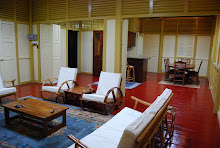
I always remember the time when my father reprimanded my cousins for breaking the back of one teak lounge chair which he had just imported from Thailand. That incident happened almost sixty years ago. Yet the evidence is there. The old teak chair is still around repaired and a vogue of the then current furniture design of Thailand. Coincidentally in many Bangkok homes and even hotels the same design and quality furniture remain as showcase till now.

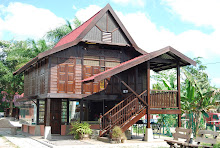
Many of us would have old treasured items stocked behind cupboards or lying unknown somewhere in the house especially if you are living in a family home several decades old. They may not be large items like antique furniture but instead such pieces as dinner plates, copper trays, silver spoons, old books, lamp shades, door locks, clocks etc. Not to forget old photographs. Their discovery and acquisition will certainly enhance our knowledge of the family's interest and standing. Even the old house you are living in has a story of its own to tell. The wood, the pillars, doors, floors and windows with their quality and characteristic design plus craftsmanship would tell of the labor and cost to build such homes then. Alas we miss out such observation but instead look to modernity and the conventional design or whatever 'masterpieces' we designated as extraordinary and worth adopting as collection pieces.

The heirlooms given a good scrub, polish and attended to with tender care will be sights to behold when they are up on the shelves or beautifully framed in the living room for you and visitors to adore.

I am happy that many of the items I value and adore are still around kept safely for others to appreciate and realise their authenticity and richness in design. Yet remembering of course those who purchased or had them as practical and usable every day items had the family close to his or her hearts and wanted for them some small luxuries in life.

I can look back and admire with much pride those collectibles which hopefully my family will continue to treasure and some unknowingly may reach the table of Sotheby if they are perfect antiques. Through them I recognised that my grandparents, father and mother who have all departed ( Al Fatihah) had left behind valuable crafts and collectibles which must have also endured their likings and fondness and yet remembering that we would continue to appreciate their intrinsic values and beauty.

More items naturally have been added since.

It will become a process of elimination when the number becomes bigger or the addition of space to accommodate the increased collections. Nevertheless displays and procedures adopted by museums or historical sites may help us in no small way to keep our collections perpetual.

It is without doubt the early attraction and familiarity with old things that have cultivated within oneself the onus to see and admire all things around and appreciate their being and hence their creativity and the people who brought them around. I count myself fortunate having lived and brought up in a family home which until today stands sentinel devoid of the destructive elements of nature and flood. Thus the collectibles being where they were.

Antique shops have yet to emerge in greater numbers, especially in smaller towns and thereby the interest will explode. Currently Malacca and Kuala Lumpur provide the connoisseurs of things they desire to keep for prosperity while indulging in all the intricacies, skills and know how of a rewarding and not necessarily expansive hobby.

In Britain the BBC has been running an 'Antique Roadshow' for years with the appraisers visiting towns throughout the country to meet collectors who bring their pieces to be judged or appraised. This perpetuate greater interest while adding knowledge and value. If only such a program can be organised in Malaysia. It is transmitted in Australia too. Hopefully this interest catches on and we will preserve our richness while guarding its transmigration.

P.S View below some of my collections and hopefully those who have not been bitten by these exciting bugs will start looking in the crevices and corners of your grandfathers' homes and discover to your greatest delights some 'treasures'. Good luck.
(1) A handmade Thai offering bowl with design motifs very much duplicated in conventional bowls found in markets and shopping malls now. It is estimated that this has been in the family since the Thai period in Kedah much before the 2nd World War.

(2) A heavy iron ball with a hole in the centre. I was told that it is a cannon ball and very much used as a 'tungku' by the women folks. Now what is a 'tungku'? It's any moderately heavy iron piece, heated and wrapped with cloth used to massage especially after delivery. One with a cannon ball piece is understood to be more 'effective'. Will be glad to receive further info.


(3) This is an Iban 'Parang Panjang' with ornate carvings on its sheath and handle. Known also as parang ilang it is a much treasured piece by the Iban of longhouses fame. I was at Marudi, a small town up river along the Baram from Miri way back in 1961 to witnesse the famous Baram Regatta and fortunately came across this piece. The parang is sharp with several design pieces inlaid.


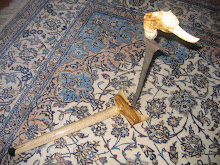
(4) " Ketam"a piece of tool which has disappeared. Carpentars now use electronic plane for all their works which previously require labor intensive attention. Other tools used by our carpentars during the last decades or so are now collective items because they reveal the intensity and mode of works.


(5) Last but not least of course the ever popular 'kopitiam'. As such as many coffee shops have sprouted out lately to cater for the taste of good coffee, nothing I believe can beat the quality of grinded coffee that came out from such machine as our mothers and grand-mothers labor to get the powder after the coffee beans have been roasted. Oh! the good home cooked food.